
Hotline:15086707142
 3 / 3
3 / 3
图片三 |
Your position: Home > News > News Information
What is Raman spectrum? |
| Publisher:Jinghong (Jiangsu) Spectrum Co.,Ltd. Release time:2025-06-25 12:51:13 Click count:72 Close |
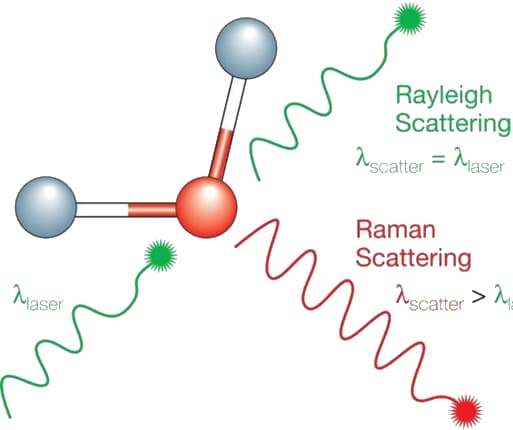 Raman is a kind of light scattering technology. When the high-intensity incident light of a laser light source is scattered by a molecule, most scattering light has the same wavelength (color) as the incident laser. This scattering is called Rayleigh scattering. However, a very small part (about 1/109) of the wavelength (color) of the scattered light is different from the incident light. The change in the wavelength is determined by the chemical structure of the test sample (so-called scattering substance), which is called Raman scattering. Raman is a kind of light scattering technology. When the high-intensity incident light of a laser light source is scattered by a molecule, most scattering light has the same wavelength (color) as the incident laser. This scattering is called Rayleigh scattering. However, a very small part (about 1/109) of the wavelength (color) of the scattered light is different from the incident light. The change in the wavelength is determined by the chemical structure of the test sample (so-called scattering substance), which is called Raman scattering. What information can Raman spectroscopy provide? Raman spectroscopy can detect the chemical structure of materials. The information it provides includes: Chemical structure and chemical identification Phase and form Strain Pollutants and impurities Not subject to industry restrictions. Typical examples of the current application of Raman spectroscopy include: Carbon materials - structure and purity, defects/disorder characterization of carbon nanotubes Chemistry - Structure, Purity, Reaction Monitoring Life science - single cell or tissue characterization, drug, disease diagnosis Pharmacy - Uniformity of drug composition and distribution of components Semiconductor - purity, doped components, stress. |

Jinghong (Jiangsu) Spectrum Co.,Ltd. TEL:15086707142 E-MALI:SHJH@cl-spectrum.com WEB: www.cl-spectrum.com ADD:Building 33, No. 58 Tonggang Road, Bixi Street, Changshu City, Jiangsu Province Su ICP No. 2026055001-1
 Scan the mobile website
 Cell phone station
