

What is Raman spectrum?
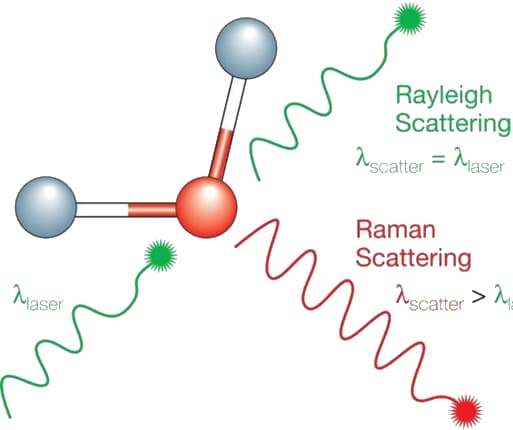 Raman is a kind of light scattering technology. When the high-intensity incident light of a laser light source is scattered by a molecule, most scattering light has the same wavelength (color) as the incident laser. This scattering is called Rayleigh scattering. However, a very small part (about 1/109) of the wavelength (color) of the scattered light is different from the incident light. The change in the wavelength is determined by the chemical structure of the test sample (so-called scattering substance), which is called Raman scattering.
 What information can Raman spectroscopy provide? Raman spectroscopy can detect the chemical structure of materials. The information it provides includes: Chemical structure and chemical identification Phase and form Strain Pollutants and impurities Not subject to industry restrictions.
Typical examples of the current application of Raman spectroscopy include: Carbon materials - structure and purity, defects/disorder characterization of carbon nanotubes Chemistry - Structure, Purity, Reaction Monitoring Life science - single cell or tissue characterization, drug, disease diagnosis Pharmacy - Uniformity of drug composition and distribution of components Semiconductor - purity, doped components, stress.